
Shopping Cart
There are no more items in your cart
- Joshua
- Tutorial and Guides
- 0 likes
- 5110 views
Belt Anatomy
Complete Guide: Classic vs. Detachable (Hermès Style)
With over 50 years of hands-on experience crafting custom belts and replacement straps in premium leather.
With over 50 years of experience in the production of custom belts and replacement straps, we explain everything you need to choose, measure, and make a quality belt last a lifetime. This guide combines real workshop knowledge with practical advice you won’t find in brand catalogs.
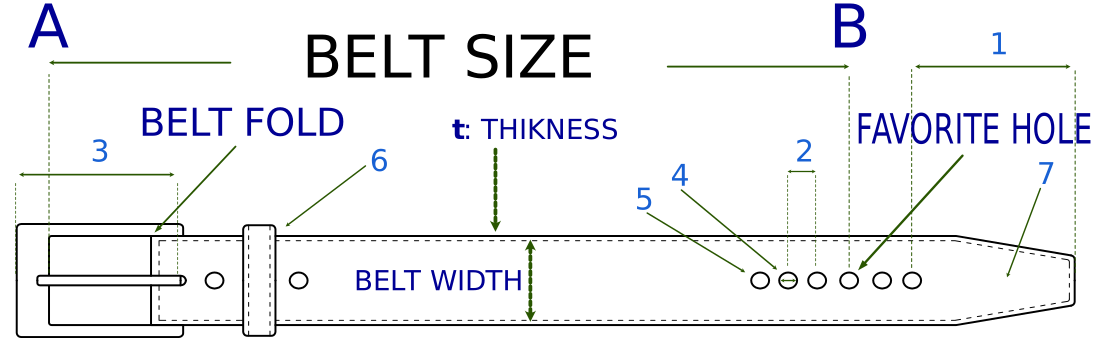
Classic Belt Detailed Anatomy
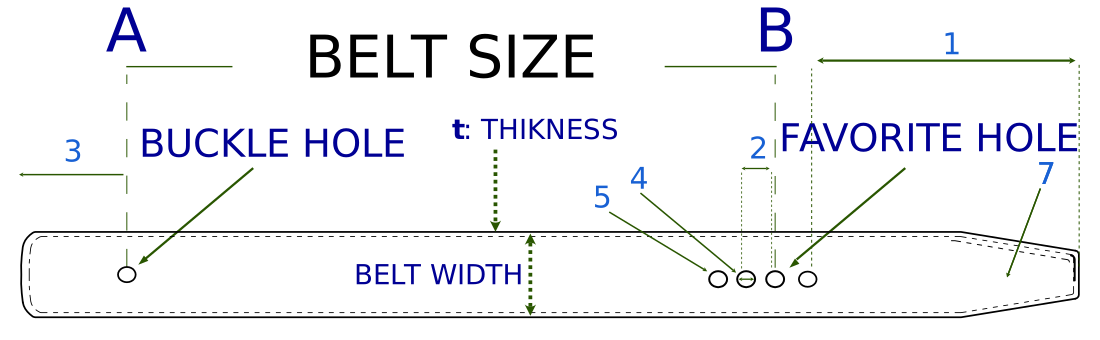
Detachable (Hermès Style) Belt Detailed Anatomy
How to Read a Belt Size Correctly
The true size of a belt must be based on the hole you use most often (the “favorite hole”), which represents the natural position when the belt is worn. Over time a belt can stretch or change shape, so the most-used hole becomes the correct reference for ordering a new belt.
- Hole spacing: generally 2.5 cm (1 inch) – rarely 2 cm
- Classic belts: usually 5 holes
- Hermès-style detachable belts: 3 holes
- Center hole (favorite hole) = the real size of the belt
Official formula :
BELT SIZE = A to B
BELT TOTAL LENGTH A to B + Tip Length (+ Buckle Length for classic belts)
The real measurement is the distance from the Belt Fold (where the leather folds around the buckle bar) to the favorite hole. This is the industry-standard method used by serious makers and designers.
Practical examples – What “Belt Size” really means
For Hermès-style (detachable) belts:
- Belt Size 90 cm (35 ½") = A + B
Total physical length ˜ 90 cm + Tip Length (12–13 cm) = 102–103 cm (40 ¼"–40 ½") - Belt Size 95 cm (37 ½") = A + B
Total physical length ˜ 95 cm + Tip Length = 107–108 cm (42"–42 ½") - Belt Size 100 cm (39 ½") = A + B
Total physical length ˜ 100 cm + Tip Length = 112–113 cm (44"–44 ½")
For Classic belts (with traditional buckle):
- Belt Size 90 cm (35 ½") = A + B
Total physical length ˜ 90 cm + Tip Length (12–13 cm) + Buckle length (2–3 cm) = 104–106 cm (41"–41 ¾") - Belt Size 95 cm (37 ½") = A + B
Total physical length ˜ 95 cm + Tip Length + Buckle length = 109–111 cm (43"–43 ¾") - Belt Size 100 cm (39 ½") = A + B
Total physical length ˜ 100 cm + Tip Length + Buckle length = 114–116 cm (45"–45 ¾")
Complete Belt Anatomy Legend
- 1. Tip Length → approx. 12-13 cm (4 ¾" –5")
Length from the tip to the last hole. Must be long enough to pass under the keeper without sticking out too much or looking too short. - 2. Hole Spacing → 2.5 cm (1") standard (rarely 2 cm)
- 3. Buckle End / Belt Fold Section
The fixed section of leather that folds around the buckle (stitched or riveted). In detachable belts it is the area where the clamp tightens. - 4. Center Hole (Size Reference)
The most-used hole – this determines the real belt size. - 5. Adjustment Holes
5 holes on classic belts, 3 holes on Hermès-style detachable. - 6. Keeper (Belt Loop / Passante)
The loop that holds the tip in place. On quality belts, it is secured with a short, thin yet sturdy leather keeper strap. - 7. Front-End Belt Tip
Final tip shape – usually tapered on classic belts (every brand has slight variations). (See all tip shapes →) - Typical Belt Width
from slim (10–14 mm) to formal (30–32 mm) up to classic/exotic (38–42 mm). Some lines go extra-wide up to 60 mm. - Thickness (t)
quality standard 2.8–3.2 mm. Some clamp-buckle models (Ferragamo, Montblanc) reach 3.47–3.6 mm. Certain short-prong Hermès removable buckles are thinner. (Discover all buckle types)
The Art of Crafting a Quality Custom Belt
Watch how we build a premium belt from start to finish in our workshop.
Wear and Longevity of High-Quality Calfskin or Exotic Leathers
With over 50 years of experience we can say that the longevity and deformation of a belt depend mainly on material quality and construction.
A full-grain calfskin belt (or alligator/crocodile), made with high-quality vachete lining and talling/salpa backing (never cardboard), has minimal stretch over time. It gently conforms to the body and remains in excellent condition even after 10+ years of intensive daily use.
Conversely, economy belts in corrected-grain leather (surface leveled to hide scars) often use low-grade reinforcements. Scrap leather mixed with chemicals and plastics frequently replaces real salpa. These belts tend to stretch up to 10 % after just 24 months, deform at the edges, and the holes tear quickly.
Little-Known Construction Details
Skiving & Reinforcement
The raw hide thickness (“substance”) ranges from 1 mm to 2.2 mm. To make it robust it is carefully skived on the flesh side, smoothed, and bonded with high-strength adhesives to tallin and salpa reinforcements.
The real skill is in the skiving process: premium leather does not need to be overly thinned because the hide itself is part of the belt’s life (this also applies to wallets and small leather goods). Budget processes use thin skins that require much thicker reinforcements. The difference is visible and tangible after a few years.
The real skill is in the skiving process: premium leather does not need to be overly thinned because the hide itself is part of the belt’s life (this also applies to wallets and small leather goods). Budget processes use thin skins that require much thicker reinforcements. The difference is visible and tangible after a few years.
Edge Coloring – The 3-Step Process
On top-tier belts edge coloring is done in three distinct stages:
- A primer is applied first so the color grips evenly without wrinkles and can be corrected if needed.
- The main edge color is applied (matched to the leather or chosen for double-face straps).
- After ~24 hours of natural drying, a reinforcing color layer is added.
Luxury Brand Sizing Differences
There are no major size differences between true luxury brands. A “90 cm” belt can vary slightly depending on buckle length and the workshop in charge of production. Most big designers do not produce belts in-house but rely on trusted third-party specialists.
Practical advice: never rely only on the old belt’s stamped size. Always re-measure from the Belt Fold to your favorite hole. The difference between pant size and belt size is usually 8–12 cm (because pants have their own thickness and cut).
| Pant Size (EU) | Recommended Belt Size (cm) | Recommended Belt Size (inches) |
|---|---|---|
| 44–46 | 80–85 cm | 31 ½"–33 ½" |
| 46–48 | 85–90 cm | 33 ½"–35 ½" |
| 48–50 | 90–95 cm | 35 ½"–37 ½" |
| 50–52 | 95–100 cm | 37 ½"–39 ½" |
| 52–54 | 100–105 cm | 39 ½"–41 ½" |
| 54–56 | 105–110 cm | 41 ½"–43 ½" |
| 56–58 | 110–115 cm | 43 ½"–45 ½" |
| 58–60 | 115–120 cm | 45 ½"–47 ½" |
Only as a reference - always measure your current belt for the most accurate result.
Anti-Loss Keeper Strap & Clamp Buckles
Production of the Anti-Loss Keeper (Fettuccina)
Our custom belts (not possible in mass production) use a thin strip of full-grain vacchetta, carefully skived and fixed to the belt strap to keep the passante from getting lost. It is slim for comfort yet robust enough to last decades.
Clamp Buckles (Montblanc & Ferragamo)
Original Montblanc and Salvatore Ferragamo clamp buckles have high-quality mechanisms that remain reliable for years.
On cheap belts the same mechanism fails quickly because the leather is too thin. The mechanism alone costs $30–50 USD – impossible on low-cost production.
Why a Belt Built the Right Way Is Worth It
A belt is not just an accessory – it is a lifelong investment when made with the right materials and techniques.
Understanding real anatomy, the difference between full-grain and corrected-grain, how to measure correctly, and which construction details matter lets you buy smarter and avoid pieces that only last a couple of seasons.
Read the Guide on LinkedIn